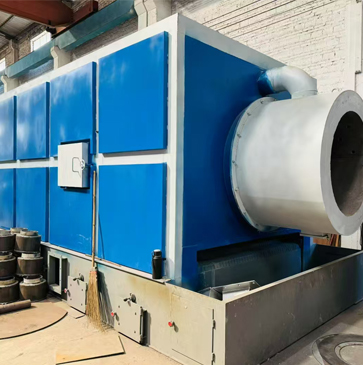
On the market, there are biomass combustion furnaces, which typically refer to biomass pellet combustion furnaces. There is also another type of furnace known as a wood chip combustion furnace, which uses unprocessed wood chips as fuel. In China, this wood chip combustion furnace is also referred to as a biomass semi-gasification furnace. Biomass wood chip fuel is evenly fed into the gasification chamber of the semi-gasification furnace via a belt conveyor. Inside, the fuel mixes with primary air uniformly supplied from beneath the grate, creating a high-temperature combustion environment of approximately 900°C. Within the furnace, the dried fuel undergoes pyrolysis, releasing volatile components such as CO, H, and CnHn, which are combustible gases. The unburned combustible gases and flames are then ejected from the furnace’s front nozzle. At the nozzle, high-speed secondary air is introduced, enabling a secondary combustion process that takes place in the secondary combustion chamber of the heating equipment. This secondary combustion raises the flame temperature to about 1100°C. This combustion method is defined as semi-gasification composite combustion technology. Its key feature involves primary air-supplied, oxygen-deficient combustion to create a high-temperature environment. Part of the fuel burns directly in the furnace chamber, while another part releases combustible volatiles under high heat. These components then undergo thorough secondary combustion at the nozzle with the introduction of secondary air. For example, measurements taken from the flue gas of a 7.2 million kcal biomass wood chip combustion furnace using a gas analyzer show an excess air coefficient (α) of 1.1 to 1.5. The external flame length at the nozzle measures between 3000–5000 mm, with a flame diameter of approximately 1200 mm.