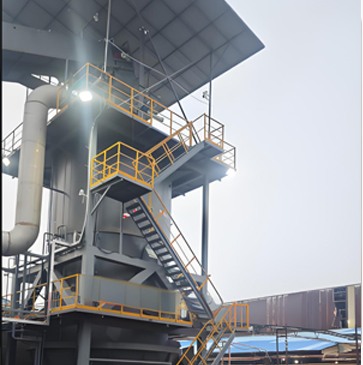
The updraft biomass gasifier is one of the earliest types of gasifiers developed. It features a simple structure and easy operation, making it particularly suitable for heating and power generation.1. Working Principle:In this design, biomass feedstock is fed from the top and moves slowly downward. The gasifying agent (air) enters from the bottom and flows upward. As the feedstock descends, it passes through the following four zones in sequence:
- •Drying Zone: Located at the topmost layer, the feedstock is heated by the rising stream of hot gas from below, causing its moisture to fully evaporate.
- •Pyrolysis Zone: The dried feedstock moves downward and thermally decomposes in a high-temperature, oxygen-deficient environment, releasing volatile gases (tars, methane, etc.) and solid char.
- •Reduction Zone: The solid char produced from pyrolysis reacts with the rising hot gases (primarily CO₂ and H₂O) from below in reduction reactions, generating combustible gases like carbon monoxide (CO) and hydrogen (H₂).
- •Oxidation Zone: Situated at the very bottom near the grate, the gasifying agent (air) is injected here. It reacts with the remaining char in intense combustion, producing high temperatures that supply the necessary heat for the zones above.
2. Main Advantages: Simple Structure, High Heating Value of Gas
- •The structure is relatively simple, leading to lower construction and operating costs.
- •Since the producer gas is drawn off directly after passing through the cooler pyrolysis and drying zones, heat exchange is efficient. This results in a lower gas outlet temperature and a heating value typically higher than that of downdraft gasifiers.
3. Main Disadvantage: High Tar Content in GasThe produced gas contains a significant amount of tar vapors generated in the pyrolysis zone. These tars condense when the gas cools, easily clogging and contaminating downstream pipes and equipment. Therefore, complex gas cleaning systems are usually required.
4. Typical Applications:
- •Primarily used for district heating or providing fuel gas for boilers and kilns.
- •If used to power internal combustion engines, highly efficient, multi-stage gas cleaning systems are essential.