🔹 1. Introduction: Why Fuel Type Matters
Biomass gasifiers are not universal systems.
👉 Choosing the right biomass gasification system depends heavily on fuel characteristics.
They must be designed based on fuel characteristics, including:
Size and shape
Density
Moisture content
Ash content
Different fuels require different gasification technologies to ensure stable combustion and high efficiency.
👉 This is why proper system selection is critical in industrial applications.
🔹 2. Common Biomass Fuel Types
Different regions use different biomass fuels, especially in Southeast Asia and industrial zones.
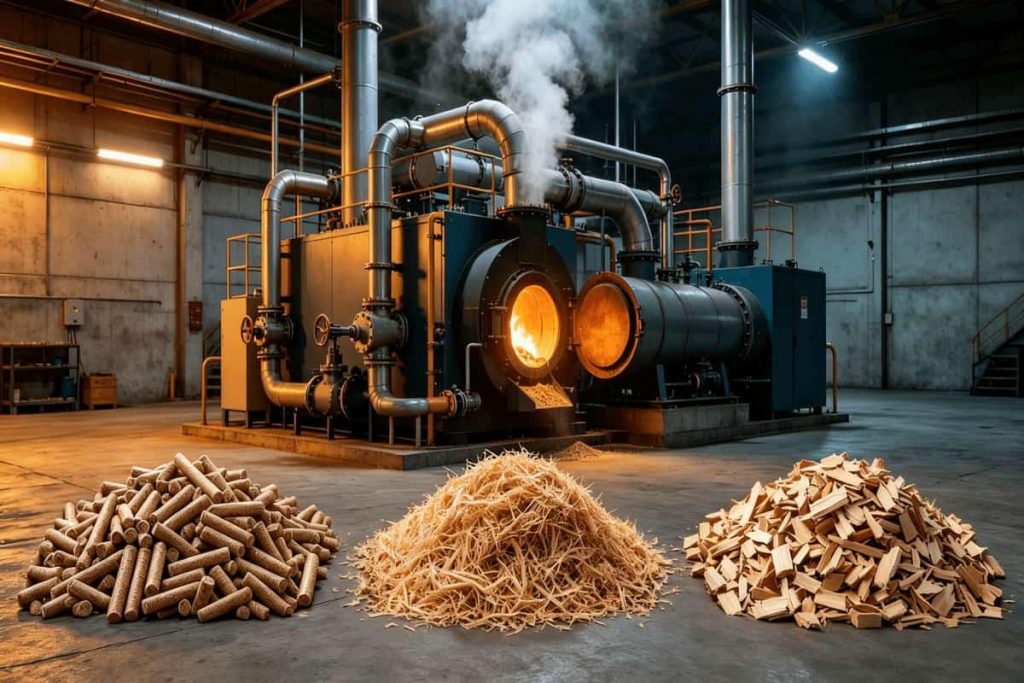
✔ Wood Pellets
Uniform size and shape
High density
Low ash content
Very stable combustion performance
✔ Rice Husk
Small and loose structure
Low density
High ash content
Requires special ash handling design
✔ Wood Chips
Irregular size
Medium density
Medium ash content
Requires strong fuel feeding system
🔹 3. Gasifier Design Differences
Different fuels require different gasifier structures.
🔥 (1) Pellet Gasifier
Pellet gasifiers are designed for uniform fuel input.
✔ Stable combustion
✔ High automation level
✔ Suitable for continuous industrial operation
👉 Learn more about our biomass gasification systems
🔥 (2) Rice Husk Gasifier
Rice husk gasifiers must handle high ash content.
✔ Anti-clogging structure
✔ Enhanced ash discharge system
✔ Designed to prevent slagging
👉 See how we apply this in industrial heating solutions
🔥 (3) Wood Chip Gasifier
Wood chip gasifiers require flexible fuel handling systems.
✔ Larger feeding system
✔ Strong air distribution design
✔ Suitable for industrial waste biomass
👉 Explore our boiler retrofit solutions
🔹 4. How to Choose the Right Gasifier
Selection depends on fuel availability and project requirements:
Stable pellet supply → Pellet gasifier
Low-cost rice husk → Rice husk gasifier
Wood waste / chips → Wood chip gasifier
👉 Proper selection directly affects:
Efficiency
Fuel consumption
System stability
Long-term operating cost
🔹 5. Why Proper Design Matters
Biomass gasifiers are highly sensitive to fuel conditions.
Incorrect selection may cause:
Low efficiency
Slagging problems
Unstable gas output
Increased maintenance cost
👉 Correct engineering design ensures stable long-term operation.
What is the best biomass fuel for gasification?
Different fuels have different performance characteristics. Wood pellets provide the most stable combustion, while rice husk requires special ash handling systems. The best choice depends on local fuel availability and project conditions.
❓ FAQ 2
Can one biomass gasifier use different fuels?
Some gasifiers can handle multiple fuels, but performance will vary. Mixed fuel operation usually requires customized design to ensure stable combustion and avoid slagging or blockage.
❓ FAQ 3
Why does rice husk need a special gasifier design?
Rice husk has high ash content and low density, which can easily cause slagging and blockage. Therefore, specialized ash discharge and anti-clogging systems are required.
❓ FAQ 4
Which biomass fuel is the most cost-effective?
Rice husk is often the cheapest, but system maintenance costs may be higher. Wood chips offer a balance between cost, availability, and operational stability.
❓ FAQ 5
How to choose the right biomass gasifier?
The selection depends on fuel type, steam demand, and operating conditions. A technical evaluation is recommended before system design and procurement.
🔹 6. Conclusion
Biomass gasification systems must be customized according to fuel type.
There is no universal design.
Proper matching between fuel and system is the key to achieving:
Stable energy output
Lower fuel cost
Efficient industrial heating
Looking for a biomass gasification solution for your factory?
We provide customized engineering design and consultation.