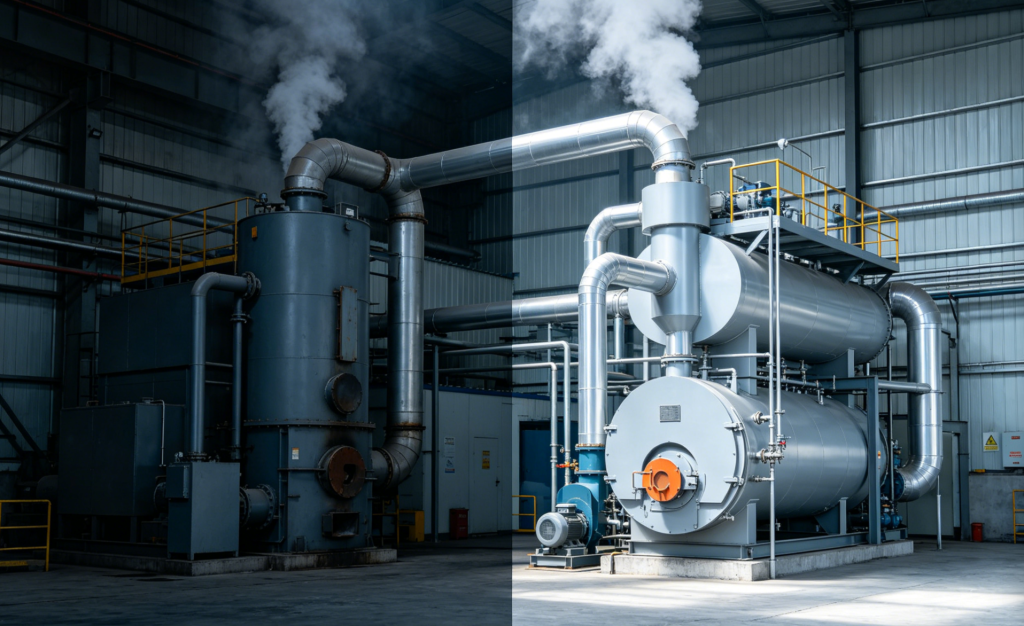
Is your industrial heating system underperforming? Comparing biomass gasifier efficiency is often the first step toward reducing your factory’s energy cost.
For biomass-based steam systems, one key metric defines project success:
👉 Biomass-to-steam efficiency (steam output ratio)
Understanding this ratio is essential for calculating real operating cost and evaluating system performance.
In recent years, more factories are replacing low-temperature gasifiers with high-temperature systems — driven by measurable gains in efficiency, lower tar issues, and faster ROI.
Common Problems
Factories using low-temperature gasifiers often face:
* Low biomass-to-steam efficiency
* High tar formation and wastewater treatment cost
* Unstable syngas affecting boiler combustion
* High specific steam consumption
* Frequent maintenance and system downtime
Why This Happens
The root cause lies in gasification temperature and reaction completeness.
Low-temperature gasifiers (400°C–600°C) cannot fully crack complex hydrocarbons, leading to:
* Lower calorific value gas
* Incomplete carbon conversion
* High tar carryover
👉 Direct Engineering Insight:
Tar formation is a direct result of low reaction temperatures (<700°C), where complex hydrocarbons fail to crack into combustible gases.
⸻
In contrast, high-temperature gasifiers (800°C–1200°C) enable:
* Near-complete tar cracking
* Higher carbon conversion efficiency
* Improved sensible heat recovery
* Higher calorific value syngas
⸻
👉 Industry Benchmark:
A high-performance gasifier should achieve:
* Carbon conversion efficiency >90%
* Stable biomass-to-steam ratio above 4.0
📊 Technical Comparison: High vs Low Temperature Gasifier
Gasification Temperature
High-temperature gasifiers operate at 800°C to 1200°C, while low-temperature gasifiers typically run at 400°C to 600°C, resulting in significantly different reaction efficiency.
Tar Conversion Efficiency
High-temperature gasifiers achieve over 98% tar cracking, whereas low-temperature systems often suffer from high tar carryover, increasing maintenance and operational complexity.
Steam Yield per Ton of Fuel
A high-temperature gasifier can produce 4.0 to 4.3 tons of steam per ton of biomass, compared to approximately 3.5 tons in low-temperature systems.
System ROI
Due to higher efficiency and lower maintenance requirements, high-temperature gasifiers typically achieve a return on investment within 12–18 months, while low-temperature systems may take 24 months or longer.
Ideal Applications
High-temperature gasifiers are best suited for high-efficiency industrial steam generation, while low-temperature gasifiers are generally used for simpler heat applications.
Solutions
为了提高效率和降低成本,工厂正在采取以下措施:
1.升级为高温气化炉
提高生物质转化为蒸汽的效率并减少能量损失
2. 优化燃料选择
适用的燃料包括:
* 模板木材废料
* 稻壳气化
* 木屑颗粒燃料
3. 现有锅炉系统的改造
降低投资,同时提升系统性能
4. 降低环境处理成本
高温系统可减少焦油废水,帮助越南、印度尼西亚和泰国的工厂遵守环境法规。
项目示例
使用模板木材废料的真实项目数据:
* 高温气化炉:
1吨 → 4.0–4.3吨蒸汽
* 低温气化炉:
1吨 → 约3.5吨蒸汽
👉 效率提升:
生物质转化为蒸汽的转化率提高 15% 至 20%
实际影响
对于日耗燃料量为 50 吨的工厂:
* 额外蒸汽:25-40吨/天
* 更低的单位蒸汽消耗量
* 更低的每吨蒸汽成本
👉 专家见解(东南亚):
在越南、印度尼西亚和泰国等高湿度地区,高温气化炉保持显热回收的能力对于实现稳定的蒸汽输出和防止效率损失至关重要。
🧠 Key Takeaway
High-temperature biomass gasifiers significantly improve biomass-to-steam efficiency by operating at higher reaction temperatures, enabling near-complete tar cracking and carbon conversion. This results in up to 20% higher steam output and lower fuel cost compared to low-temperature systems.
⸻
Related Solutions
👉 Biomass Gasification System for Boilers
👉 Boiler Retrofit for Alternative Fuel
👉 Industrial Heating System Optimization
FAQ
1. What is biomass-to-steam efficiency?
It measures how much steam can be generated from one ton of biomass fuel.
⸻
2. Why does my biomass system produce too much tar?
Because the gasification temperature is too low (<700°C), preventing complete cracking of hydrocarbons.
⸻
3. How much efficiency improvement can I expect?
Typically 15–20% higher steam output compared to low-temperature gasifiers.
⸻
4. Is high-temperature gasifier more expensive?
No. In many retrofit projects, total investment can be lower due to simpler downstream systems.
⸻
5. Is it suitable for Southeast Asia fuels?
Yes. It works well with rice husk, wood waste, and other locally available biomass fuels.
⸻
6. Can I calculate my cost savings?
Yes. A steam cost calculator based on your fuel and system can estimate ROI quickly.
Conclusion
Upgrading to a high-temperature gasifier is not just a technical improvement — it is a strategic move to increase energy efficiency and reduce operational cost.
For industrial steam systems, improving biomass-to-steam efficiency is the most direct way to enhance profitability.
CTA
Upgrade your industrial biomass gasification system today for higher steam yield and lower fuel cost.
👉 Contact us for a tailored system evaluation and cost-saving analysis.
Let’s discuss your project and see what
improvement is possible.
WeChat (Scan QR Code)