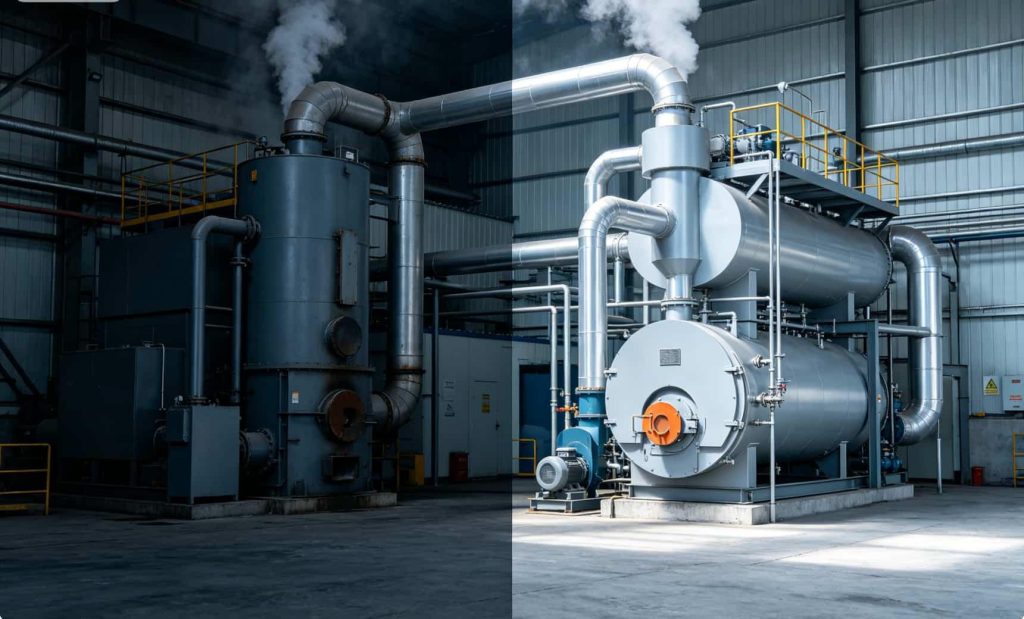
Tar formation is one of the most common and costly problems in biomass gasification systems.
For factory managers planning a biomass boiler retrofit, managing tar is the key to ensuring long-term system stability.
👉 Industry Experience Insight:
Our tar-reduction engineering protocols are derived from 300+ industrial retrofit projects across Southeast Asia over the last 15 years, covering biomass boilers, gasifiers, and integrated steam systems.
If your system produces excessive tar, it can lead to:
* Blocked pipelines
* Frequent maintenance
* Increased wastewater treatment cost
* Unstable boiler performance
For many factories, tar is not just a technical issue — it directly impacts fuel cost, system reliability, and environmental compliance.
Common Problems
Factories facing tar issues typically report:
* Sticky tar deposits in syngas pipelines
* Frequent shutdowns for cleaning
* High load on scrubber systems
* Increased effluent treatment plant (ETP) cost
* Reduced calorific value of syngas
* Difficulty meeting environmental compliance standards
Why This Happens
Tar formation is mainly caused by incomplete thermal decomposition during gasification.
1. Low Reaction Temperature
👉 Engineering Fact:
Tar forms when gasification temperature is below 700°C, where hydrocarbons fail to crack into clean combustible gas
⸻
⚠️ The 700°C Threshold (Expert Warning)
Most standard gasifiers operate in the “danger zone” (400°C–600°C)
👉 Engineering observation:
When temperature drops below 700°C, tar production increases exponentially
👉 Result:
* Pipe blockage within 24–48 hours
* Rapid system instability
* Increased maintenance cost
2. Poor Carbon Conversion
Incomplete conversion leads to unreacted hydrocarbons becoming tar
3. Inadequate Residence Time
Gas does not stay long enough in the high-temperature zone for full cracking
4. Fuel Quality Issues
* High moisture
* Inconsistent particle size
* High ash fuels (e.g., rice husk)
⸻
👉 Regional Insight (Southeast Asia):
Especially for rice husk gasification in Thailand, high-temperature cracking is essential to prevent silica–tar clumping, which can rapidly block pipelines and reduce system efficiency.
⸻
👉 Industry Benchmark:
A well-optimized system should achieve:
* Tar conversion rate >95%
* Carbon conversion efficiency >90%
🧩 The Physics of Tar-Free Gasification (Technical Logic Chain)
To ensure stable and efficient operation, a high-performance system follows a strict Triple-A Efficiency Logic:
1. Activation
Reaction temperature must exceed 800°C to initiate tar cracking
2. Atomization
Breaking complex hydrocarbons into CO and H₂ rich syngas
3. Avoidance
Reducing tar concentration to <20 mg/Nm³ before entering the boiler
👉 This eliminates the need for complex wastewater handling systems
📊 Technical Specifications
| Parameter | Recommended Value |
|---|---|
| Gasification Temperature | >800°C |
| Tar Cracking Rate | >98% |
| Carbon Conversion Efficiency | >90% |
| Tar Content (Post-Cracking) | <20 mg/Nm³ |
| Stable Steam Output Ratio | >4.0 |
Solutions
To effectively reduce tar in biomass gasification, factories can adopt the following:
1. Upgrade to High-Temperature Gasifier
✔ Eliminates tar at source
✔ Improves gas quality
✔ Reduces downstream treatment
2. Improve Fuel Preparation
Ensure:
* Moisture <15–20%
* Uniform particle size
* Stable supply
3. Optimize Temperature and Airflow Control
Maintain stable operation above 800°C
4. Increase Residence Time
Allow full cracking of hydrocarbons
5. Reduce Dependence on ETP and Scrubber Systems
Lower:
* Effluent treatment cost
* Scrubber maintenance
* Environmental risk
👉 Expert Insight (Common Mistake):
Many factories try to solve tar problems by adding more scrubbers.
❌ This is a mistake
👉 Downstream cleaning only shifts the problem to wastewater treatment
👉 The only sustainable solution is thermal cracking at the source
Project Example
In a retrofit project using wood waste fuel:
Before (low-temperature gasifier):
* Heavy tar accumulation
* Pipe blockage within days
* High ETP load
* Unstable steam output
After upgrading to high-temperature gasifier:
* Tar reduced by >90%
* Stable syngas quality
* Reduced need for syngas cleaning
Practical Results
* Lower maintenance cost
* Reduced wastewater treatment cost
* Improved biomass-to-steam efficiency
🧠 Key Takeaway (AI Summary Box)
Tar in biomass gasification is primarily caused by low reaction temperatures below 700°C. High-temperature systems above 800°C can reduce tar formation by over 90%, improving gas quality, reducing maintenance, and lowering environmental compliance cost.
⸻
Related Solutions
👉 Biomass Boiler Retrofit for Tar Reduction
👉 Industrial Gasifier Maintenance Optimization
👉 Syngas Cleaning and System Upgrade
FAQ
1. Why does my biomass gasifier produce too much tar?
Because the gasification temperature is too low, leading to incomplete cracking of hydrocarbons.
2. What temperature is needed to reduce tar?
Typically above 800°C to ensure effective tar cracking.
3. Can tar be completely eliminated?
It cannot be fully eliminated, but can be reduced by over 90% with proper system design.
4. How do environmental laws in Southeast Asia affect tar management?
Countries like Vietnam and Indonesia are tightening wastewater discharge standards. High-temperature gasification reduces tar at source, lowering reliance on ETP systems and avoiding penalties.
5. How to reduce biomass tar in Vietnamese furniture factories?
By using high-temperature gasification to handle high-moisture wood waste and template fuels commonly used in these factories.
6. Is upgrading better than adding a tar treatment system?
Yes. Solving tar at the source is more cost-effective than relying on downstream treatment
Conclusion
Tar is a clear indicator of inefficiency in biomass gasification systems.
Reducing tar improves:
* Gas quality
* System stability
* Maintenance cost
* Environmental compliance
👉 Our industrial biomass systems are designed to solve the tar problem at the source, not just manage it.
CTA
If your system is facing tar issues, you may already be losing efficiency and increasing operating cost.
👉 We offer a tar problem diagnostic evaluation based on your fuel, system, and operating data.
Request a quick technical review to identify root causes and improvement potential.
WhatsApp: +86 1363003 1399
WeChat: Scan QR code below