Biomass Gasification vs Direct Combustion: Environmental Compliance and Industrial Emissions Comparison
🟦 INTRODUCTION
A biomass gasification project recently experienced an unexpected suspension during the installation phase, despite having already passed environmental approval and completed equipment manufacturing.
The reason provided was a regulatory request to pause construction due to concerns that:
👉 “Biomass direct combustion may be cleaner than gasification systems.”
This situation highlights a common misunderstanding in industrial energy transition projects:
Is environmental performance determined by the technology itself, or by the system engineering behind it?
🟨 H2:Biomass Gasification vs Direct Combustion – Technical Overview
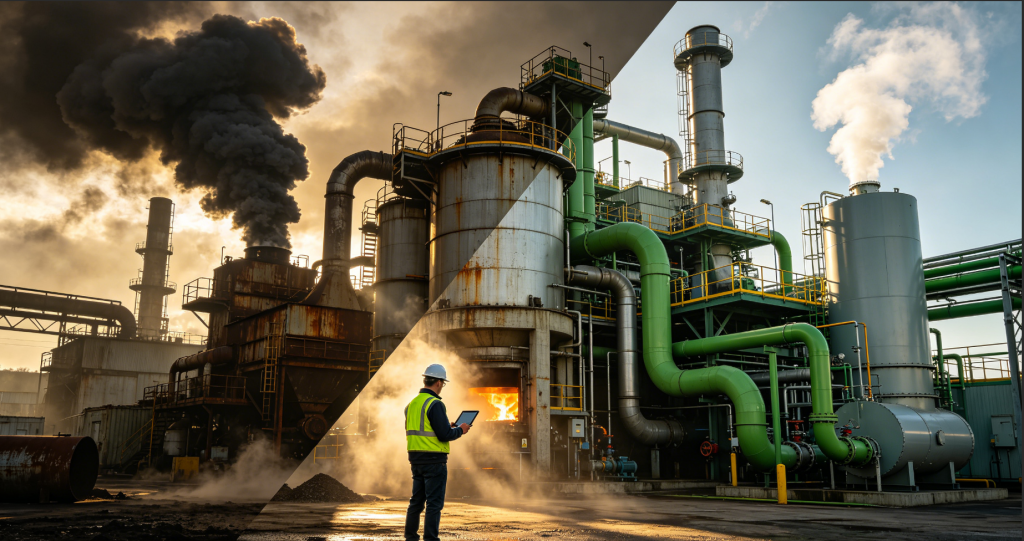
From an engineering perspective, biomass energy systems should not be evaluated only by labels, but by how emissions are generated and controlled.
🔴 Direct Combustion Systems
In direct combustion systems, biomass materials such as wood chips, straw, or pellets are burned directly in a boiler furnace to generate heat.
Key characteristics:
- Single-stage combustion process
- High dependence on furnace stability
- Difficult real-time emission control
Emission challenges:
- Particulate matter (PM) from incomplete combustion
- Nitrogen oxides (NOx) due to high combustion temperature
- Smoke, tar, and unburned hydrocarbons during unstable operation
Explore Biomass Combustion Solutions
🟢 Biomass Gasification Systems
In biomass gasification systems, fuel undergoes thermal decomposition under oxygen-limited conditions to produce syngas, which is then combusted in a controlled environment.
Key characteristics:
- Two-stage process: gasification → syngas combustion
- Centralized gas cleaning before combustion
- More stable combustion control
Emission control advantages:
- Tar removal through gas cleaning systems
- Particulate filtration before combustion
- Lower NOx formation due to controlled flame temperature
🟩 CONCLUSION
From an industrial engineering perspective:
- Well-designed biomass gasification systems with proper gas cleaning can achieve lower particulate and NOx emissions compared to traditional direct combustion systems
- However, poorly designed systems may perform worse than expected
- Direct combustion systems can also achieve compliance, but often require more complex and costly flue gas treatment systems
👉 The real decision factor is not “gasification vs combustion”, but:
system engineering design, emission control strategy, and operational stability
📩 CTA
If you are evaluating biomass energy projects or facing environmental approval challenges, we can support with:
- Technical feasibility assessment
- System design optimization
- Boiler and furnace retrofit engineering
- EPC technical cooperation
📱 Contact Us
👉 WhatsApp: https://wa.me/8613630031399
👉 Or contact us via: /contact-us
👉 Get a project quotation: /get-a-quote
👉 Scan to Connect on WeChat