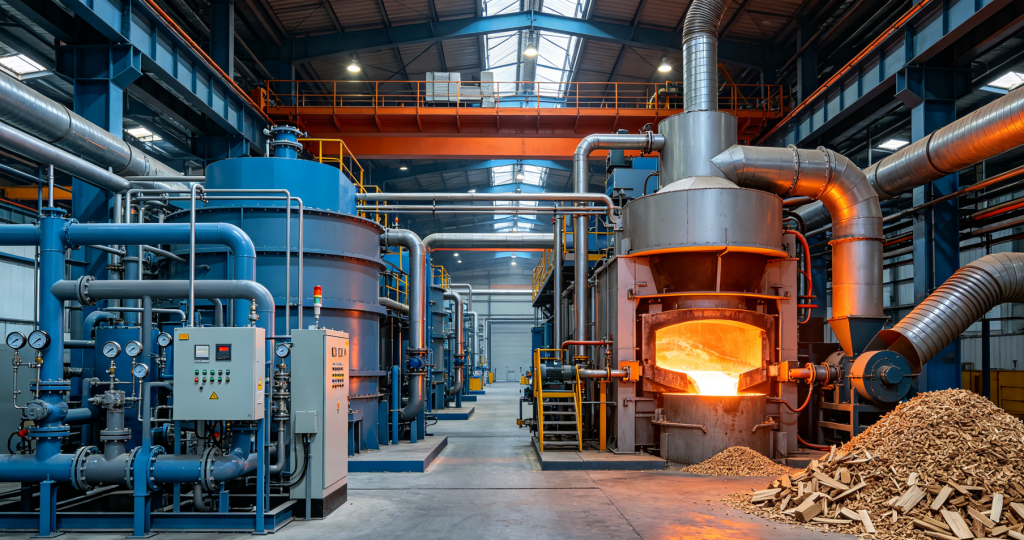
Many aluminum plant owners are now exploring biomass energy solutions to reduce rising natural gas costs and improve long-term energy stability.
However, converting an aluminum melting furnace from natural gas to biomass is not a simple fuel replacement.
It is a full industrial energy system transformation that involves engineering, operations, compliance, and fuel logistics.
🧩 Key Feasibility Factors for Biomass Retrofit
1. Factory Space and Fuel Storage Conditions
One of the first constraints in biomass retrofit projects is available space.
Natural gas systems require minimal infrastructure, while biomass systems require:
- Fuel storage yard
- Fuel handling and feeding system
- Equipment installation space
👉 In many cases, space availability determines whether a project is technically feasible.
👉Learn more about our
industrial biomass gasification systems for heating applications
2. Environmental Compliance and Regulations
Environmental approval is a critical step in any industrial energy retrofit.
Compared to natural gas, biomass fuel systems may require:
- Environmental impact assessment (EIA)
- Emission compliance review
- Local regulatory approval
In some regions, additional flue gas treatment systems may also be required.
Explore our
industrial heating solutions compliant with emission regulation
3. Operational Staffing and System Management
Natural gas furnaces are highly automated and require minimal operation.
In contrast, biomass systems require:
- Fuel feeding control
- Combustion monitoring
- Ash removal
- Temperature regulation
👉 This creates a significant requirement for trained operators and system management capability.
Discover our
boiler and furnace retrofit engineering services
⚠️ Why Many Biomass Retrofit Projects Fail
Most failed aluminum furnace retrofit projects are not caused by equipment issues, but by system-level gaps:
- Lack of operational preparation
- Improper space planning
- Unclear environmental approval path
- Missing skilled operators
👉 The real issue is system mismatch, not technology failure.
🏭 Industrial Biomass Energy Implementation Models
✅ Solution 1: Outsourced Thermal Energy Supply Model
In this model, the factory does not directly manage equipment.
A third-party energy provider is responsible for:
- System construction
- Fuel supply
- Continuous operation
The factory only pays for actual energy consumption.
✅ Solution 2: Equipment Retrofit + Full Operation Outsourcing
In this model:
- Biomass equipment is installed on-site
- Factory invests in system upgrade
- Operation is fully outsourced to professional teams
👉 This ensures stable production while reducing operational burden.
📊 Industrial Insight
Energy optimization in aluminum melting furnaces is not just fuel switching.
It requires:
- Engineering design
- Operational capability
- Regulatory compliance
- Fuel supply stability
👉 The real goal is cost reduction without production disruption
📩 Need Technical Evaluation?
If your aluminum plant is considering:
- Natural gas to biomass conversion
- Furnace energy optimization
- Gasification system feasibility study
- Operational outsourcing models
👉 A professional technical evaluation is strongly recommended before investment decisions.
Contact us for
technical consultation for biomass retrofit projects
👉 Talk to an Energy Engineer Now
🟢 WhatsApp(International Clients)
📱 WeChat(China Clients)